The phone rings and someone needs two brackets. Not two hundred, two. It feels like easy money. The drawing is simple, the material is on the rack and the laser is free this afternoon. Then the job is done, and when you add it up honestly, the two brackets paid for about half the time they took.
Small orders are not bad work, but they come with two problems. The first is the customer. A buyer asking for one or two parts often expects the price per piece they would get on a run of hundreds. The second is the quote itself. When the price is built from run time, by hand or by an automated quoting tool, the setup gets left out or spread too thin, and on a few parts the setup can take as long as the cutting. The job ends up taking about twice the time you quoted.
Why Short Runs Cost More Per Piece
Every job has costs that do not care about the quantity. Somebody opens the drawing, checks it, programs it, pulls the sheet, loads the machine, cuts a first part, checks it, writes the paperwork, and stages the parts for pickup. That work is exactly the same for one part as for one thousand. On a big run it disappears into the price. On two parts, it is most of the price.
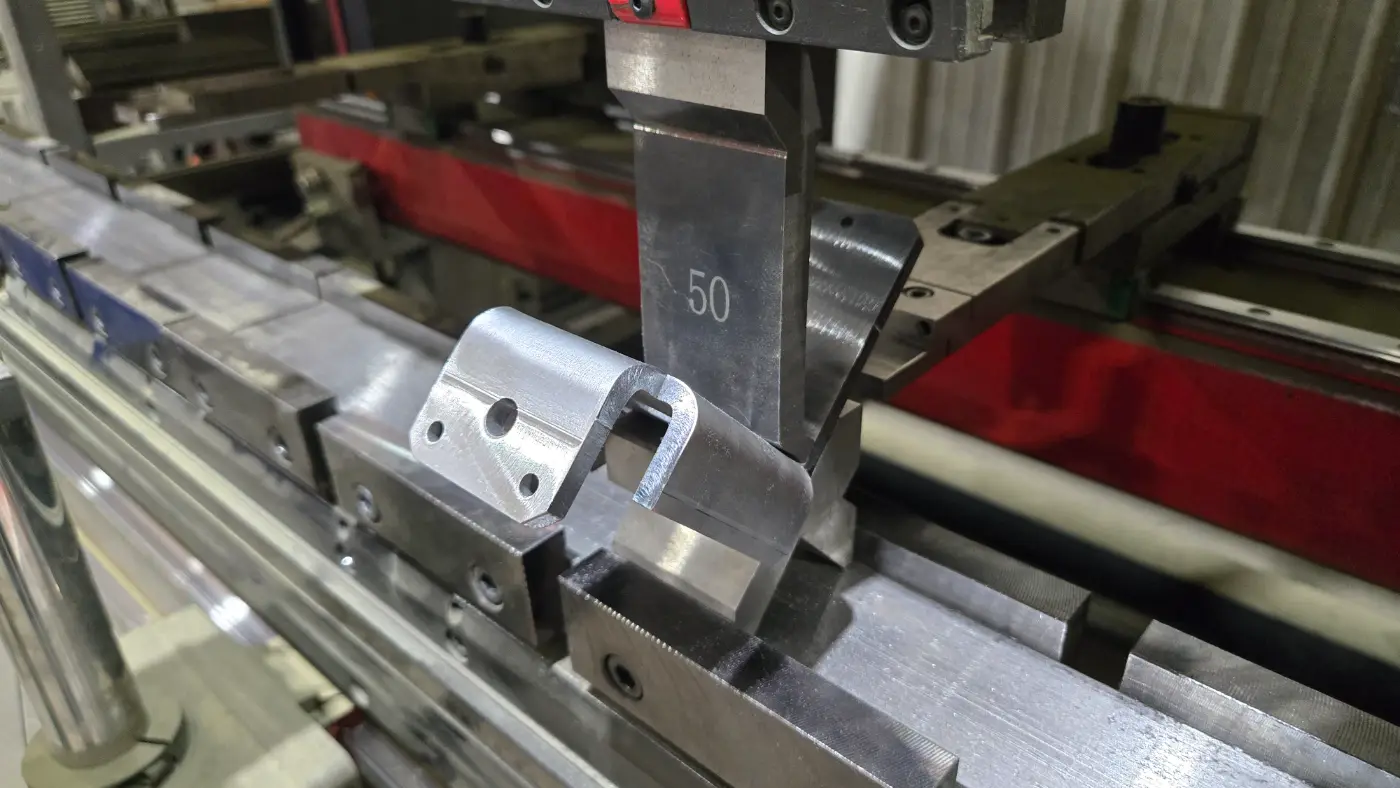
And cutting is only the first setup. Every step the part goes through has its own.
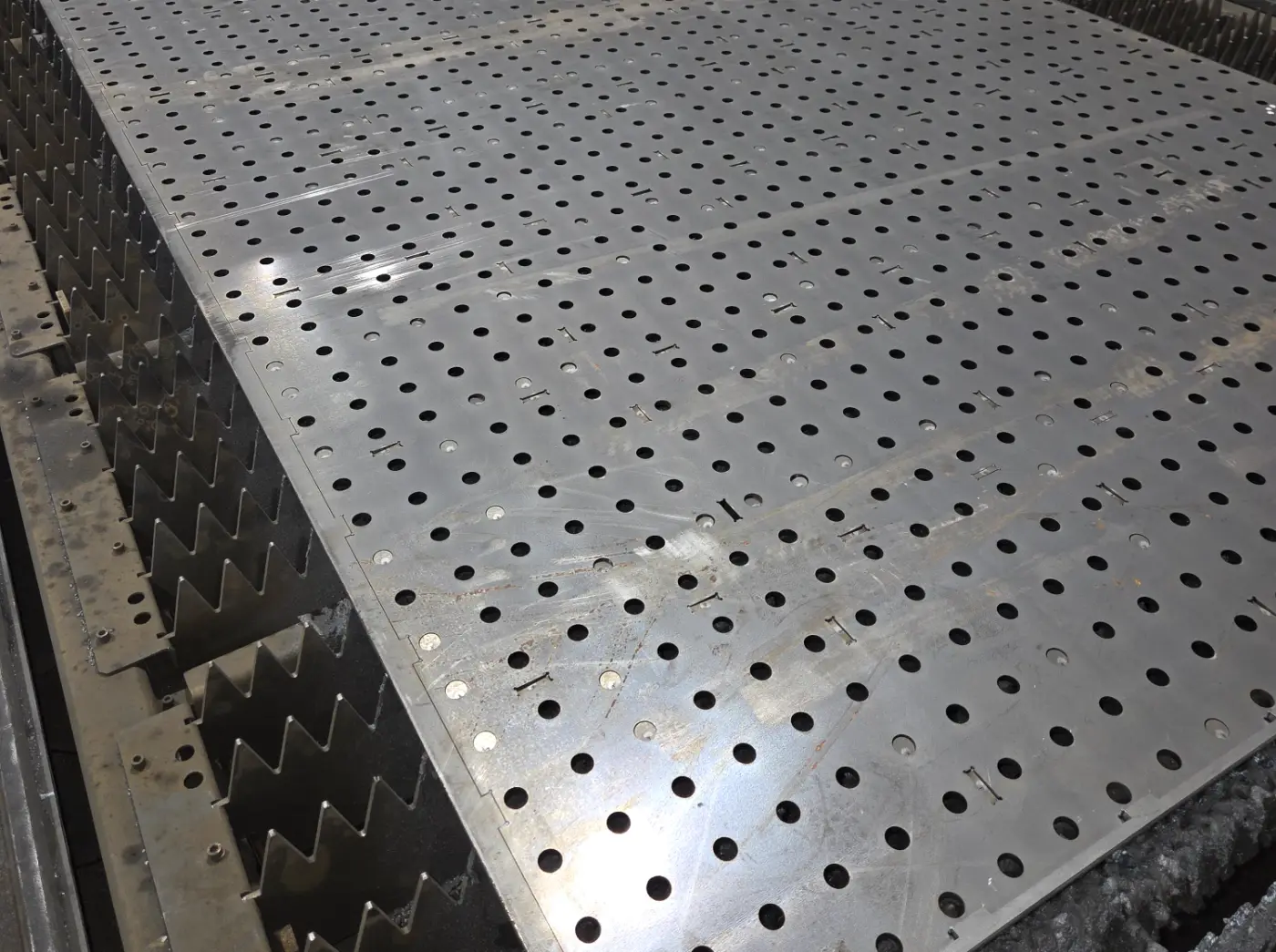
- Material. Pulling the sheet, moving it, loading it on the table, and getting the leftover back on the rack.
- Bending. Setting up the tooling on the brake and bending a test part before the real ones.
- Powder coat. Hanging, masking and running the line, whether the rack holds one part or fifty.
- Programming and paperwork. The same time at any quantity.
Stack those on a single piece and the price climbs fast, and that is just what the piece really costs.
Break Out the Costs That Are Not Free
Most buyers ask for a price per piece, and they should get one. But some costs on a small job are worth showing on their own line, so the customer can see what they are paying for.
Engineering is the clearest example. A customer brings in a cardboard template and needs it drawn up before anything can be cut. That drawing is real work. Put it on the quote as its own line, and it tells the customer two things.
- What they are asking for is not free. If they can draw it themselves, they might. If not, they know why the price is what it is.
- The cost is worth spreading. Once they are paying for the drawing, ordering more parts makes each one cheaper. Some customers will order more on their own once they see that.
Decide What a Small Order Has to Pay For
Before the next short run comes in, settle a few things so you are not deciding on the phone.
- Know your setups. Time a few real setups for cutting, bending and coating, and turn them into dollar figures at your shop rate.
- Decide on the sheet. If a small order uses a sheet you will not use again, charge for the sheet. If the drop goes back on the rack and gets used, charge for what the parts used.
- Price per piece work per piece. Tapping eight holes is eight holes on every part, at any quantity.
- Show the price per piece and the totals. The buyer sees what each part costs, the line total and the quote total.
A small order is still a whole job. The quantity is just smaller.
Small Orders Are Worth Having
None of this means turning short runs away. We have seen it in our own shop. The customer who needed two brackets in a hurry is often the one who calls with the big order later, and sometimes what won them was not the price at all. It was how fast the parts were ready. The goal is only that the small order pays for itself, so it is a good order and not a favor.
Quote your next short run with the setup built in
Set your setup fees once, and every quote spreads them across the pieces. Try it free for 5 days or 10 quotes, whichever comes first.
How Accuracy Quoting Prices Small Orders
Accuracy Quoting builds the setup into the quote for you, so a short run is priced like a short run.
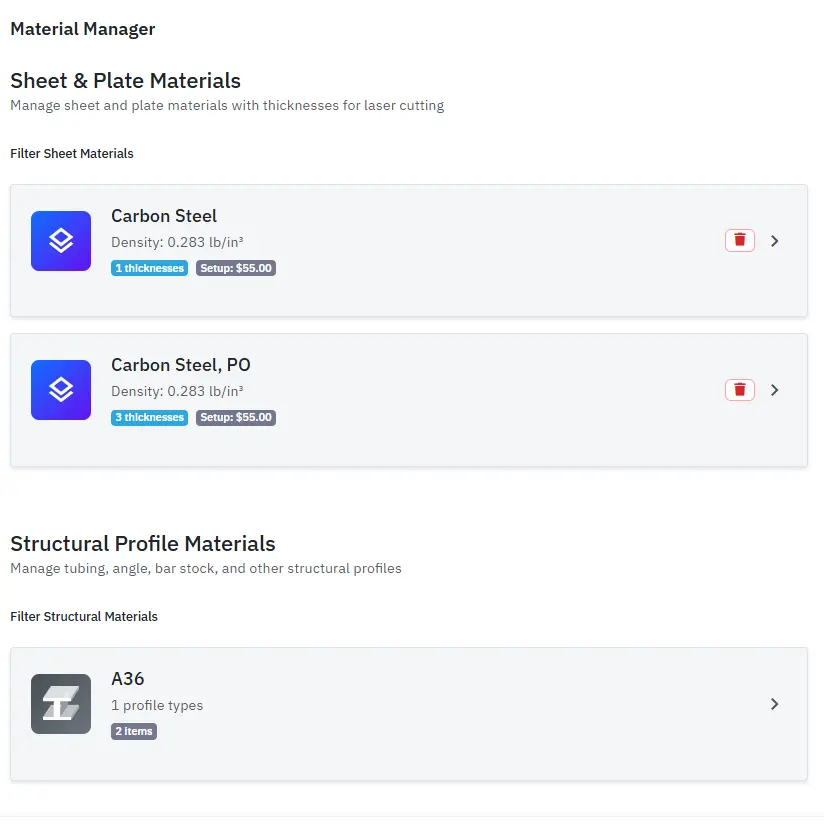
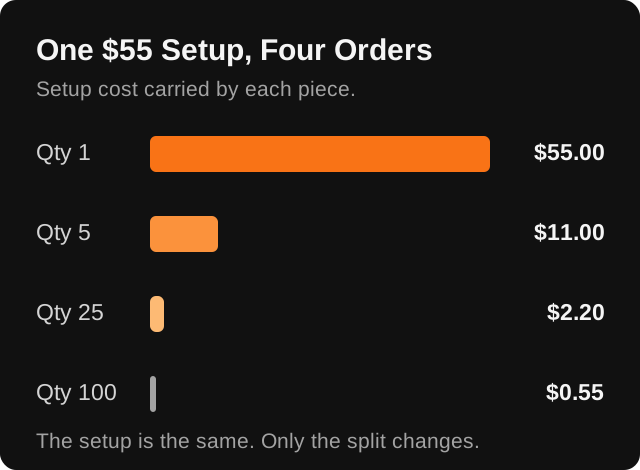
- A setup fee on each material. Set it once in the material manager. On a quote, it is shared across every piece of that material and thickness, so one piece carries the whole fee and a hundred pieces split it.
- Setup on bending and powder coat. Each formed part carries a bend setup cost, divided across the pieces on its line. With the STEP to Flat Pattern add on and your dies set up, parts bent on the same die share one setup across the whole quote. Powder coat has its own setup too, divided across the quantity on the line.
- Engineering on its own line. Add a simple part named for the work, such as drawing a part from a customer's template, and price it from a cost row. It prints on the customer's quote as its own line.
- Per piece operations. Tapping, countersinking, hardware and deburr go on as tasks. A task can be a flat price per piece, a count times a price (per hit), or hours at a labor rate. Tasks are charged on every piece, at any quantity.
- Charge full sheet. When a small order uses up a sheet, one button charges the whole sheet.
- A clear quote for the buyer. The quote shows the price per piece, the line total and the quote total, with your logo, lead time and terms.
Common Questions
Should I charge a setup fee on small orders?
Yes. Programming, loading the machine, checking the first part and the paperwork happen whether you cut one part or a thousand. If that time is not in the price somewhere, the short run pays for it out of your margin.
Why does a small order take longer than I quoted?
Usually because the quote was built from run time and the setup was left out or spread too thin. On one or two parts, setting up the laser, the brake or the paint line can take as long as running the parts, so the job takes about twice the time you priced.
Do I charge for the whole sheet on a small order?
If the leftover is not a drop you will realistically use, yes. A small order often ties up a full sheet of a material you do not stock, and that sheet is part of the job.
How does Accuracy Quoting handle setup on small orders?
You set a setup fee on each material, and it is shared across every piece of that material and thickness on the quote. Bending and powder coat carry their own setup too. One piece carries the whole setup, and a hundred pieces split it.